{{ name }}
Article no. {{ combinedCodeWithHighlight }}
Article code:
EAN / GTIN:
Manufacturer number:
Cat. Nr.:

Kordel Antriebstechnik GmbH has automated its gearbox production facility with a pallet handling system, helping it to compensate for the current shortage of skilled workers. As a result, it became necessary to accelerate the quality assurance process, without forfeiting precision and process reliability.The solution, provided by the Hoffmann Group, involved a new method for digitally transferring measurement data from the measuring tool to the horizontal setting device.
Dirk Strotmann’s team at Kordel Antriebstechnik GmbH have to set up to 90 dial indicators every day. Even with a horizontal setting device, this is a time-consuming process given there are 12 to 15 different components per day. In addition, typos and incorrect numbers repeatedly caused problems in the past. However, this has not been an issue ever since the company stopped entering the data manually, and instead started reading it digitally into the setting device directly from the reference device.
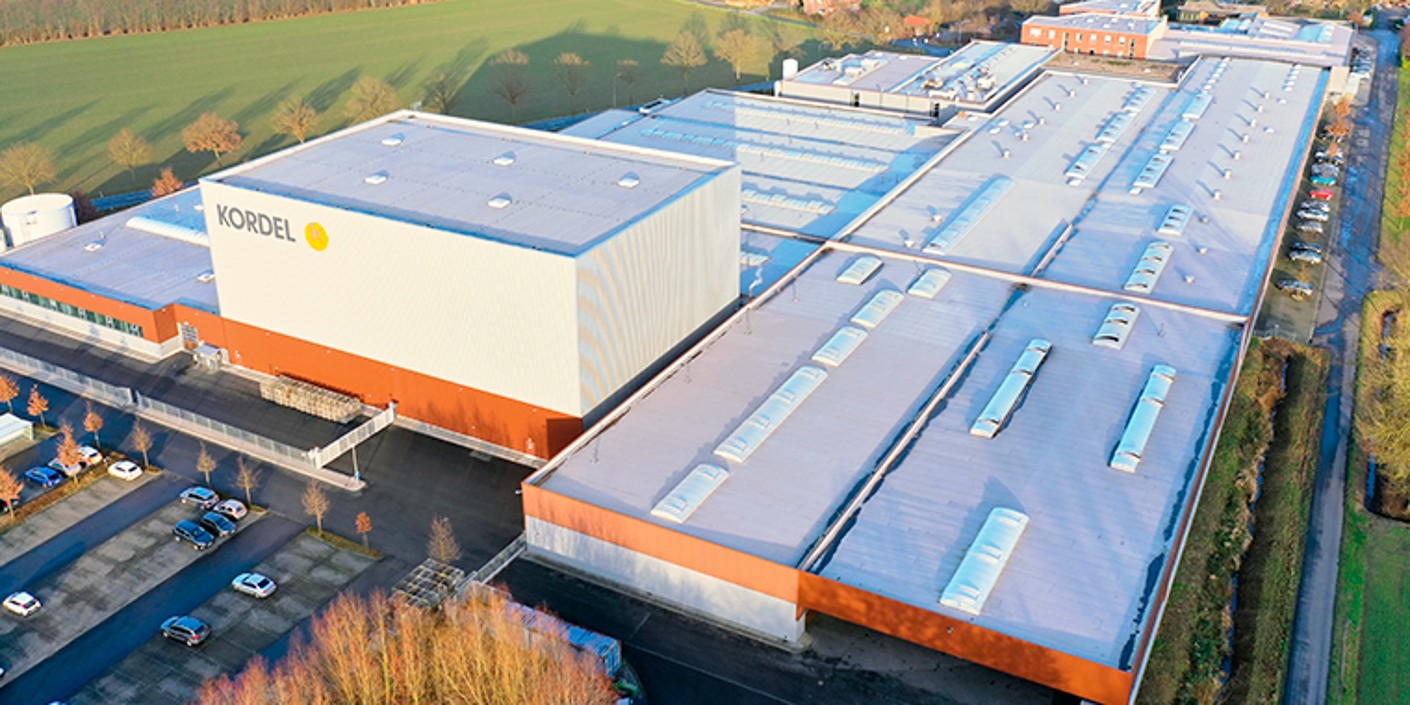
Kordel Antriebstechnik GmbH, a family-owned company, produces around 325,000 gearboxes for industrial trucks, agricultural machinery and construction machinery every year, with a level of integrated manufacturing that is remarkably high for this industry. The company manufactures and fits around 25,000 parts itself – every work step, including things like heat treatment, is covered. Dirk Strotmann is in charge of housing machining at the main plant in Dülmen-Rödder, North Rhine-Westphalia. He is responsible for the production of gearbox parts and gearbox housings and can call on 16 machining centres for this. His machines include several four-axis machines and mill-turn centres as well as a deburring cell where the housings are reworked.
“An order typically has a lot size of 5 to 30 parts. But we can also only produce four parts if someone needs us to,” says Strotmann. “Many customers now repeatedly order smaller quantities instead of placing a large order. We therefore have to convert the machines often and re-adjust the reference measuring tools for quality controls more frequently. This is the reason why we purchased horizontal setting devices for the Housing Production department some time ago,” says Strotmann.
In order to increase the level of automation in the Housing Production department, Kordel introduced the PHS 1500 Pro pallet handling system from Liebherr in Dülmen in 2019 and at the Jawor site in Poland in 2018, and adapted it to suit their specific needs. In Dülmen and Jawor, the increasing shortage of skilled workers was the decisive factor behind the decision to automate production. The system was designed with two lines to enable very frequent cycles. Both lines consist of a material storage system and production system with a storage and retrieval unit each, and permanently communicate with each other via the shared control system. They are designed for up to six machines. Currently, five identical machining centres are located at each of the two locations. The system supplies the machining centres (where cast-iron and aluminium gearbox parts are drilled and milled) with material – from the store to the machine and back again. The quality controls had to be adapted to the cycle rates of the automated system without compromising quality assurance.

Dirk Strotmann wondered whether the data input process could be radically simplified in situations where the team had to repeatedly calibrate dial indicators that had the same data. He asked the manufacturer of his horizontal setting device for a solution – but without success: “They didn’t manage it, and three other suppliers weren’t able to either. I then approached Marcel Haufe, a measuring technician from the Hoffmann Group, to discuss my problem,” says the machining manager.
“It was an interesting question that I was glad to take with me to my next meeting with our product managers,” remembers Marcel Haufe. “When developing new product ideas, we are keen to incorporate the wishes of our customers. Our product managers are therefore very open when a customer has a specific requirement.” Kordel was thus hopeful of a solution.
About six weeks later, the news came that a solution had indeed been found. A few months earlier, the Hoffmann Group had presented the new horizontal setting device – the GARANT Setting Bench SB1 – at the EMO 2019 trade fair.
When setting a measuring tool, this makes it possible to print the data relating to the measurement, together with the date and time, on a self-adhesive label in order to mark the measuring tool. By scanning the QR code on the label, the device automatically sets the measurement values that are stored there – making the process more reliable and reducing the time taken for repeated calibration. The GARANT Setting Bench also provides a tolerance calculator as drawings in the context of the ISO fit systems often only state the tolerance class (e.g. H7). For example, for the dimension 90 H7, the tolerance calculator displays the maximum and minimum permissible values (90.035 and 90.00 mm) and the average value of 90.017 mm. The user now selects the appropriate dimension. There is no need to refer to the engineer’s reference handbook, saving time and reducing additional input errors.
The results of the three-month practical test were very pleasing all round: “The GARANT Setting Bench makes calibration very quick,” explains Strotmann. “Our employees can now easily keep up with the extreme cycle frequencies and our processes are more reliable. Since we constantly re-measure the same dimensions, the ability to apply the measurement data to the dial indicators and read it in using a scanner is very advantageous.” It is only when the item master record is updated and a new dimension is added to the range that a dial indicator has to be set again and the relevant label printed out. At Kordel, the foreman is responsible for doing this. Each day they mark which dial indicators will be used and they take care of the initial calibration of the dial indicators if there are any new dimensions. To do so, they type the dimensions on the touch screen, print the new label using the label printer and stick it to the tool. The computer-assisted quality assurance system (CAQ) provides the exact values.
Since the dial indicators must be checked regularly during a shift, there is a GARANT Setting Bench SB1 located at each end of the 45-metre-long production hall in Dülmen. Six employees use the devices every shift. At Kordel, work is carried out in three shifts from Monday to Saturday morning. After the GARANT Setting Bench SB1 went down very well amongst the employees in Dülmen, in January 2021 Kordel ordered two more for the plant in Poland where large-scale series production takes place. “In Jawor there is a severe shortage of skilled workers and we have to train a lot of new employees. The Setting Bench means this goes quickly and ensures reliable processes,” reports Strotmann.

The GARANT Setting Bench SB1 has now been in use at Kordel for well over a year. Strotmann still thinks it’s great: “It’s incredibly useful and using it is child’s play.” The new GARANT Setting Bench SB1 has made processes much more reliable and significantly reducedstress amongst the workforce. He is also impressed by the Hoffmann Group’s customer service. “They listened to our needs, took them seriously, developed a solution and implemented it in a timely manner.”